SingularityNET: True AGI Requires Neural-Symbolic Approach, Not Just Scaling LLMs
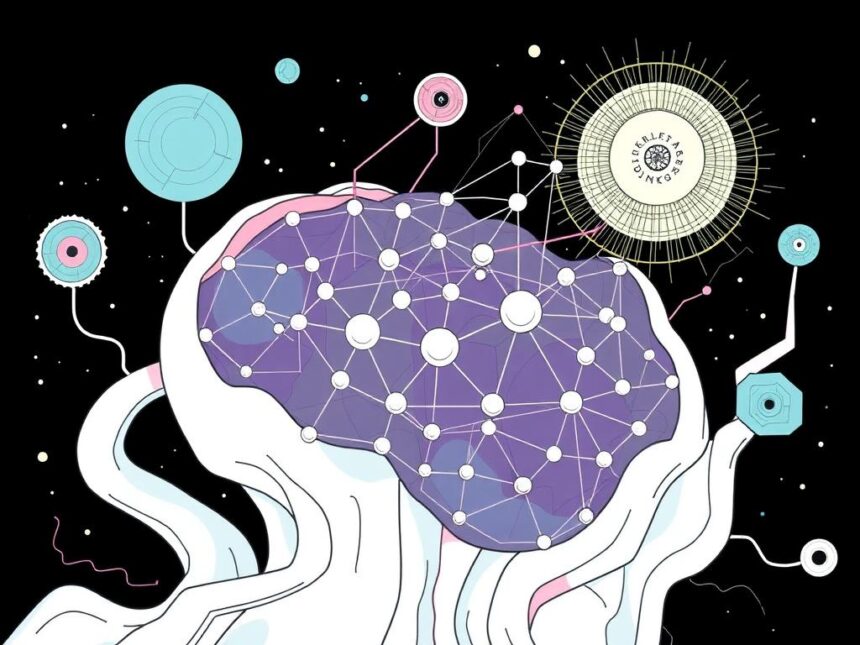
In a statement, SingularityNET argued that Large Language Models should be treated as peripheral ‘lobes’ in an AGI architecture, with a neural-symbolic system like OpenCog Hyperon serving as the cognitive core.
Facts, in 30 seconds
- SingularityNET argues that simply scaling up current Large Language Model (LLM) architectures is not a viable path to Artificial General Intelligence (AGI) [1][2].
- The organization advocates for a neural-symbolic-evolutionary approach, highlighting its OpenCog Hyperon project as the necessary cognitive core [1][2].
- In its proposed model, LLMs would function as specialized, plug-in “lobes” for tasks like perception or language, rather than the central cognitive system [1].
- According to SingularityNET, the core of a true AGI must be a metagraph capable of holding editable memories and self-modifying code [1].
AI research firm SingularityNET has challenged the prevailing industry trend of scaling Large Language Models (LLMs) as the primary path to achieving Artificial General Intelligence (AGI) [2]. In a public statement on August 10, 2025, the organization, led by CEO Ben Goertzel, asserted that a fundamentally different architecture is required for true, human-level artificial intelligence [1].
The firm’s position echoes sentiments from other prominent AI researchers, including Google’s François Chollet. SingularityNET referenced a statement from Chollet, who noted, “AGI might happen soon-ish, but won’t be coming from scaling up current systems, which makes it tricky to time” [1]. Building on this, SingularityNET argued that the current LLM-centric approach lacks the capacity for genuine reasoning, memory editing, and self-improvement necessary for AGI.
A Neural-Symbolic Core
Instead of relying on scaled-up neural networks alone, SingularityNET advocates for a hybrid model. “What we need for AGI is a neural-symbolic-evolutionary approach, namely OpenCog Hyperon,” the organization stated [1]. OpenCog Hyperon is SingularityNET’s framework designed to serve as the “cognitive hub” of an AGI system [1][2].
According to their proposal, this central hub must be built upon a “metagraph that holds editable memories, self-rewriting code” [1]. This structure combines the pattern-recognition strengths of neural networks with the logical reasoning and explicit knowledge representation of symbolic AI, allowing the system to learn, reason, and adapt in a more robust and transparent way.
The Role of LLMs as Peripheral ‘Lobes’
SingularityNET’s vision does not discard LLMs entirely. Instead, it relegates them to a supporting role. The project envisions LLMs being “treated as a plug-in perceptual or linguistic ‘lobes,’ not as the cognitive hub” [1]. In this architecture, an LLM could handle natural language processing or interpret sensory data, feeding its output to the OpenCog Hyperon core for higher-level reasoning and decision-making.
This modular approach, the company argues, more closely mirrors the structure of the human brain, where specialized regions handle specific tasks under the coordination of a central cognitive framework. By focusing on a neural-symbolic core, SingularityNET aims to build an AGI capable of more than just sophisticated pattern matching, targeting a system with genuine understanding and adaptability.
Original Source: Link